
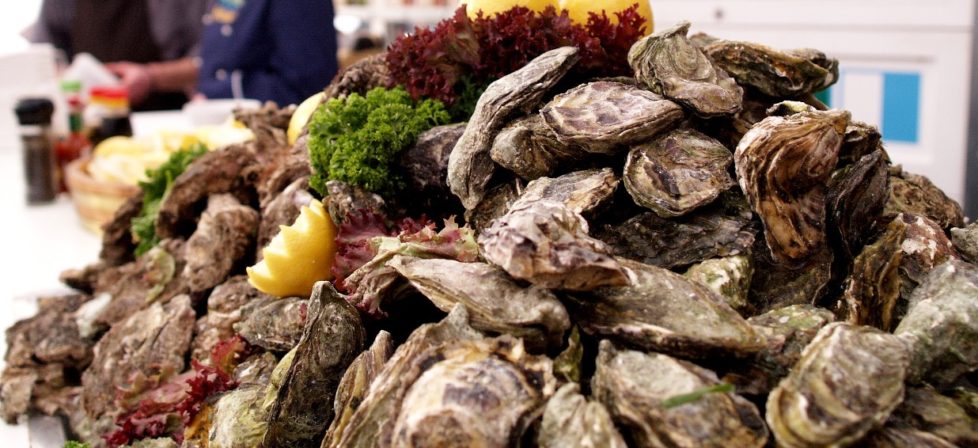
Oysters have long been the delicacy of choice for gourmands, romantics and those who appreciate the finer things in life. Oysters have also long been synonymous with Knysna and locals and visitors alike enjoy these delectable morsels throughout the year. And of course, in between enjoying our oysters, visitors relax at their comfortable B&B, guesthouse, self catering apartment or boutique hotel room.
Knysna boasts two delicious varieties of oyster – the cultivated oyster which is farmed, in part, right here in the world famous Knysna estuary and the wild, coastal variety that grows en masse along our coastline.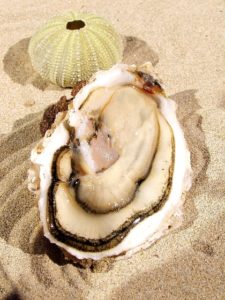
Knysna has a long history of oyster farming with the first experiments with cultivated oysters having started in 1946. In 1948 a joint venture between the Fisheries Development Corporation and Thesen & Co. gave birth to the Knysna Oyster Company. The company’s first employee, a Dutch farmer, began experimenting with methods developed in Holland, utilising oysters imported from Portugal, Australia and Britain and oyster beds made of asbestos roofing tiles.
Production finally took off in the 1970’s when the Pacific Oyster or Crassostrea gigas was found to be perfectly suited to the South African market in terms of growth rate and taste and today the Knysna Oyster Company farms 4 hectares of our estuary.
But these oysters are extremely well travelled. Once an oyster larva attaches itself to the substrate, it is called a ‘spat’. Spats are imported from France and Chile and, at approximately three months old, begin their South African residency at a nursery in Algoa Bay. Once they’ve outgrown the nursery they are transferred to the Knysna estuary.
Here they enjoy a healthy childhood inside fine mesh bags that are attached to racks within the intertidal zone. They grow strong shells as they are thinned out and turned on a regular basis and continue to grow as they are placed in larger bags, facilitating feeding and water flow. These healthy youngsters spend their last three months increasing their flesh to shell ratio and preparing for their big debut on plates in Knysna, around South Africa and even abroad.
But the real treasures are the indigenous, wild, coastal oysters found in abundance not only along the coastline’s intertidal zone, but also in deeper – yet dive-able waters. Crassostrea margaritacea, are large, fleshy, best eaten raw with a bit of black pepper and lemon juice, and have a distinctly different deliciousness about them.
Oyster pickers obtain licences from Marine and Coastal Management (MCM) and sell their fresh pickings to the Knysna Oyster Company and local restaurants. MCM also regulates this sustainable industry. And as long as you are in possession of a valid angling or bait collecting license, private individuals are also allowed to collect coastal oysters according to the relevant license and regulations.
Rich in vitamins A, B2, B12 and C, twelve natural oysters contain little more than 100 calories derived from protein not fat and, as their high salt content stimulates the gastric juices, oysters are the perfect hors d’oeuvre – especially when enjoyed with a glass of Knysna’s own Mitchell’s finest draft.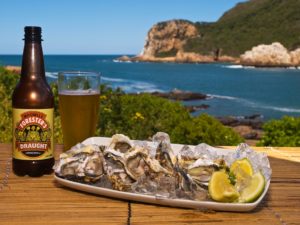
So head on down to Knysna, get your angling and/baiting license and go on the hunt. Or simply book at table at one of our fantastic restaurants and let the hunt come to you.